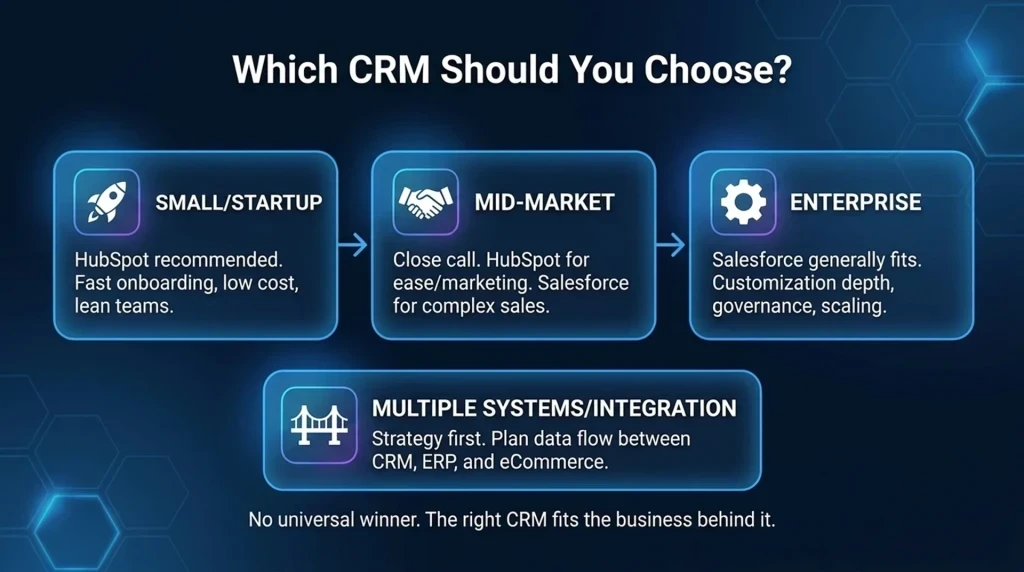
Enterprise CRM selection in 2026 is a foundational business-architecture decision rather than a software purchase: platforms are shifting from passive systems of record to autonomous agentic execution layers. With 54% of sales teams now deploying AI agents and realistic 50-seat annual total costs of ownership ranging from $46,800 to over $200,000, selecting the right platform requires diagnosing whether your primary operational gap lies in customer engagement, ERP production flow, or inbound velocity.
As advisory firm Huble observed, “Enterprise CRM selection is a business-architecture decision, not a software purchase: total cost of ownership, integration and governance outweigh feature lists.” Technology leaders facing a replatforming cycle must look past surface-level interface demonstrations to evaluate structural data models, tokenized agentic consumption fees, and multi-year maintenance realities.
The 2026 Shift from System of Record to Agentic Execution
In 2026, enterprise CRMs function as autonomous orchestration platforms rather than passive databases. Platforms deploy agentic AI—like Salesforce Agentforce—to autonomously qualify leads, research prospects, and trigger cross-system workflows without human prompts. Consequently, technical evaluation prioritizes clean underlying data schemas, agentic execution limits, and bi-directional ERP integration over static UI features.
Advisory firm Huble reports that enterprise procurement teams are replacing fragmented point-solution stacks with unified platforms to lower overhead and unify customer intelligence. The operational cost of maintaining disconnected tools for lead scoring, call transcription, and sequence automation has outpaced the administrative cost of centralized enterprise CRM platforms.
Gartner’s 2024 empirical survey of 1,026 B2B sellers revealed that representatives who effectively partner with AI tools are 3.7 times more likely to meet quota than non-users. That performance gap explains why adoption has accelerated: Salesforce’s 2026 State of Sales report found that 54% of surveyed sales professionals now work alongside AI agents in daily operations.
The introduction of Salesforce Agentforce in late 2024 established the technical blueprint for this transition. Rather than functioning as responsive chatbots waiting for user prompts, agentic engines evaluate incoming signals, research target accounts, update pipeline fields, and trigger multi-step fulfillment workflows autonomously. When an inbound inquiry arrives, an agent can verify inventory data, qualify customer credit profiles, and generate customized contract terms without human intervention.
These autonomous workflows fail when deployed on poor data foundations. Industry analysis emphasizes that artificial intelligence capabilities deliver value only when underlying data is structured, deduplicated, and consistent. When account records contain conflicting field definitions or fragmented hierarchies, autonomous agents execute flawed operations at scale, generating hallucinated correspondence and routing opportunities to incorrect territories.
Mapping Platforms to Your Operational Gaps
Selecting an enterprise CRM requires determining where institutional friction originates before committing capital. Anantharaman Veeraraghavan, analyzing technology selections for manufacturing enterprise leadership, frames the essential diagnostic question: “Where does our biggest operational gap live – in how we sell and serve customers, or in how we produce and deliver products?”
Enterprise CRM migrations establish a 5 to 10 year technological commitment. Architectural misalignments compound over time; attempting to force an engagement engine into complex industrial supply chain workflows or forcing an ERP database into high-velocity marketing pipelines leads to systemic project failure.
Veeraraghavan’s Operational Gap Triage Framework directs RevOps and enterprise architects to evaluate three core operational axes:
- Customer Engagement Complexity: Highly matrixed global accounts requiring customized opportunity routing, deep partner relationship management, and complex multi-layered CPQ schemas.
- Production and Delivery Alignment: Operational environments where order fulfillment, inventory availability, project accounting, and shop-floor manufacturing data dictate sales commitments.
- Inbound Marketing Velocity: High-volume content-driven revenue engines requiring rapid content publishing, frictionless lifecycle stages, and direct alignment between digital marketing touchpoints and sales pipelines.
Customer Engagement Complexity: Salesforce
Salesforce serves organizations with complex multinational account hierarchies, distributed territory assignments, and dedicated partner sales channels. Its architecture supports bespoke object relationships, specialized industry cloud configurations, and programmatic territory management rules across global business units.
Production and Delivery Flow: Microsoft Dynamics 365
Microsoft Dynamics 365 Sales bridges the divide between customer interactions and back-office execution. For manufacturing, logistics, and engineering enterprises where sales commitments depend on ERP inventory, bill-of-materials tracking, and production scheduling, Dynamics 365 delivers operational visibility within a single unified stack, eliminating fragile middleware synchronization.
Inbound Marketing Velocity: HubSpot Enterprise
HubSpot Enterprise is built for organizations whose revenue model centers on digital demand generation, content pipelines, and unified go-to-market execution. By integrating marketing automation directly into the customer database without configuration latency, it accelerates commercial teams where adoption speed outweighs deep custom schema engineering.
True Total Cost of Ownership and AI Consumption Limits
Sticker prices represent a fraction of the capital required to run an enterprise CRM. While vendors advertise entry tiers ranging from $105 to $175 per user per month, true financial exposure stems from professional services, mandatory marketing add-ons, storage fees, and consumption-based agentic AI execution credits.
Base Licensing vs. Realistic 50-Seat TCO
Audited enterprise pricing collected by Clarity reveals substantial divergence between list prices and actual enterprise commitments. Salesforce Sales Cloud Enterprise lists between $165 and $175 per user per month. Microsoft Dynamics 365 Sales Enterprise lists at $105 per user per month, with the Sales Premium tier priced at $150 per user per month including native Copilot capabilities. HubSpot Sales Hub Enterprise lists at $150 per seat per month, while complete HubSpot Enterprise platform packages start at 3,300 €/month.
For a typical 50-person commercial organization, realistic annual expenditures diverge significantly from base seat math:
- Salesforce Enterprise: $120,000 to $200,000 per year once standard administrative seats, Premier Support, and required database storage pools are calculated.
- Microsoft Dynamics 365: $46,800 to $80,000 per year for enterprise deployments, providing a lower recurring cost footprint.
- HubSpot Professional to Enterprise: $54,000 to $72,000 per year at the professional tier, scaling higher as contact tiers and advanced governance hubs are activated.
Implementation consulting introduces another major first-year cash requirement. Professional services for Dynamics 365 average $15,000 or more, whereas typical year-one Salesforce deployments for even a 10-person team exceed $37,000 in third-party consulting, schema configuration, and training. Essential add-ons inflate these baselines further; adding Pardot marketing automation to Salesforce introduces a recurring cost of $1,250 per month.
The total cost of ownership model below contrasts headline sticker pricing against audited 50-seat enterprise expenditure profiles and professional service onboarding requirements.
Platform Edition |
Advertised Base License |
Implementation & Onboarding |
Realistic 50-Seat Annual TCO |
Add-On & AI Cost Drivers |
|---|---|---|---|---|
Salesforce Sales Cloud Enterprise |
$165–$175 / user / month |
$37,000+ (consulting & configuration) |
$120,000–$200,000 / year |
$1,250/mo Pardot add-on; Agentforce consumption credits |
Microsoft Dynamics 365 Sales Enterprise |
$105 / user / month ($150 for Premium) |
$15,000+ (professional services) |
$46,800–$80,000 / year |
Included Copilot in Premium; Azure capacity consumption |
HubSpot Sales Hub Enterprise |
$150 / seat / month (3,300 €/mo platform) |
Mandatory onboarding packages |
$54,000–$72,000 / year (Pro tier baseline) |
Contact tier expansion; specialized Hub additions |
These comparative figures demonstrate why procurement teams must evaluate year-one cash outflows alongside multi-year maintenance projections to avoid unexpected budgetary shortfalls.
Agentic AI Credit Pools and Token Exposure
Industry analysis confirms that Salesforce carries an accessible entry point but expands into the most expensive platform once automation tools, AI modules, and support tiers are integrated. In 2026, autonomous agentic operations introduce variable consumption exposure on top of static seat licensing.
Salesforce Agentforce and Microsoft Copilot deploy usage-based billing models tied to autonomous workflow executions and underlying token consumption. When an autonomous agent completes an end-to-end task—reading an inbound RFQ, querying an enterprise ERP for current price books, enriching account history, and compiling a proposal—it consumes action credits. Uncapped agentic routines triggered by automated bulk workflows can exhaust quarterly credit allotments within days.
Warning: Enterprise contracts lacking hard execution ceilings expose organizations to severe second-year budget inflation. IT procurement teams must demand contractual rate-lock caps on autonomous agentic execution credits, specify fixed burst-rate pricing, and mandate real-time consumption thresholds before signing multi-year agreements.
Comparing Salesforce, Dynamics 365, and HubSpot
Salesforce dominates deep customization and expansive ecosystem reach with 6,000+ AppExchange tools, but requires heavy administrative overhead. Microsoft Dynamics 365 offers unmatched native integration for organizations built on Azure and Microsoft 365 at lower licensing tiers, while HubSpot Enterprise prioritizes rapid organizational adoption and unified go-to-market data at lower configuration friction.
Comparative industry benchmarks and manufacturing analysis highlight distinct architectural philosophies across the three market leaders. Choosing between them requires balancing architectural customization depth against organizational agility and administrative overhead.
Salesforce: Extensibility and Enterprise Ecosystem
Salesforce Sales Cloud remains the standard for organizations requiring custom data architecture and third-party software interoperability. With over 6,000 applications on the Salesforce AppExchange, organizations can connect specialized configure-price-quote tools, billing engines, and industry-specific data layers. Underlying schemas powered by Salesforce Data Cloud support complex polymorphic data models, multi-subsidiary rollup reporting, and granular record-level sharing rules. Maintaining this architecture requires dedicated certified administrators, programmatic Apex development, and continual governance to avoid technical debt.
Microsoft Dynamics 365: Unified ERP and Office Ecosystem
Microsoft Dynamics 365 Sales capitalizes on the global scale of the Microsoft ecosystem, which serves 1.5 billion daily users. Built on Microsoft Dataverse, Dynamics 365 shares a common data model with Power Platform, Microsoft 365, and Azure. For enterprises running Dynamics 365 Finance and Supply Chain Management (or legacy SAP Sales Cloud and Oracle CX environments), it eliminates external integration middleware. Sales reps interact with CRM data directly within Outlook and Microsoft Teams, lowering training overhead while maintaining unified operational visibility between customer commitments and ERP execution schedules.
HubSpot Enterprise: Time-to-Value and Low Overhead
HubSpot Enterprise approaches enterprise revenue operations from the perspective of adoption speed and low administrative friction. While HubSpot maintains a permanently free tier for up to 2 users for foundational contact management, its enterprise offering features over 2,000 ecosystem integrations and a unified Smart CRM data model. Unlike legacy platforms that require dedicated developers to modify standard objects or establish workflow triggers, HubSpot allows RevOps managers to deploy pipeline modifications and reporting dashboards within hours. It sacrifices hyper-custom multi-level object inheritance to maximize daily seller compliance and accelerate time-to-value.
The comparison table below evaluates Salesforce Sales Cloud, Microsoft Dynamics 365 Sales, and HubSpot Sales Hub Enterprise across architectural foundation, licensing, ecosystem scope, and operational profile.
Evaluation Dimension |
Salesforce Sales Cloud |
Microsoft Dynamics 365 Sales |
HubSpot Sales Hub Enterprise |
|---|---|---|---|
Base Tier List Price |
$165–$175 / user / month |
$105 / user / month |
$150 / seat / month (3,300 €/mo base) |
50-Seat Realistic Annual TCO |
$120,000–$200,000 |
$46,800–$80,000 |
$54,000–$72,000 (Pro) to $100,000+ |
Typical Implementation Cost |
$37,000+ |
$15,000+ |
$6,000–$15,000 |
Certified Integration Ecosystem |
6,000+ AppExchange applications |
1.5 billion daily Microsoft platform users |
2,000+ marketplace integrations |
Autonomous AI Architecture |
Agentforce autonomous workflows |
Dynamics 365 Copilot & Azure AI Studio |
HubSpot Breeze AI agents & Smart CRM |
Primary Architectural Fit |
Complex multi-tier global enterprise models |
Unified ERP, supply chain, and Office estates |
Rapid adoption, inbound-driven revenue teams |
Assessing these structural attributes enables IT steering committees to align technical capabilities with departmental workflows rather than generic feature checkmarks.
Why Enterprise CRM Implementations Fail
Enterprise CRM rollouts represent significant capital commitments, yet write-offs remain frequent across large organizations. Industry research from advisory firm Huble demonstrates that enterprise CRM failures are overwhelmingly driven by lack of user adoption rather than technology limitations; change management, not software capability, converts licensing expenditure into operational return.
As CRM Force notes, “The best CRM is the one your sales team will actually use. An enterprise platform that goes unloved is a liability, not an asset.” When daily frontline interaction degrades, data entry ceases, forecasting degrades, and autonomous AI recommendations become unreliable.
Enterprise software advisory firm Clarity warns that “Buying ahead of complexity is the more expensive mistake of the two.” When an organization with straightforward sales operations procures an enterprise-grade platform designed for matrixed multinationals, the governance machinery—intricate validation rules, mandatory multi-field layouts, and strict permission sets—becomes pure operational drag. Sales representatives circumvent the system, reverting to local spreadsheets and personal calendars.
RevOps leaders must safeguard their deployments against recurring structural failure modes:
- Premature Schema Over-Engineering: Mandating fifty required fields on lead creation overwhelms sales teams, inducing immediate user adoption failure and data fabrication.
- Defective ERP and Commerce Field Mapping: Discrepancies between CRM account records and back-office ERP master data lead to synchronization failures, billing disputes, and invalid inventory visibility.
- Unbudgeted Add-On Accumulation: Overlooking add-on software requirements—such as marketing automation platforms like Pardot ($1,250/month), sandbox environments, and storage expansion tiers—leads to mid-deployment budget crises.
- Underestimating Implementation Partner Competence: Treating systems integration as a secondary procurement item. Selecting a generalist partner unfamiliar with industry-specific schemas guarantees misconfigured workflows and multi-quarter launch delays.
Implementation Warning: Autonomous agentic AI models amplify underlying data flaws exponentially. If core ERP product catalogs, price books, and account hierarchies contain duplicate or conflicting values, autonomous agents will execute erroneous actions across enterprise customer channels without human oversight.
Executing the RFP and Pre-Contract Technical Validation
Executing an enterprise CRM procurement cycle requires structured technical validation rather than vendor-curated software demonstrations. To prevent procurement stall and eliminate vendor spin, enterprise technology leaders utilize the 30-day technology selection method paired with a disciplined Rapid RFI and Rapid RFP sequence.
Shortcut: Accelerate vendor shortlisting by deploying a 5-day Rapid RFI focused strictly on architectural non-negotiables—ERP connectors, data sovereignty, and identity federation—before issuing a detailed RFP to no more than three qualifying finalists.
The Rapid RFP and 30-Day Sourcing Sequence
Traditional six-month procurement timelines introduce organizational fatigue and technological obsolescence. The 30-day selection framework compresses evaluation into structured milestones:
- Week 1 (Architectural Triage): Establish mandatory technical requirements using the Eight-Dimension Enterprise CRM Scorecard, covering data architecture, security compliance, scalability, integration flexibility, agentic AI readiness, field workforce support, administrator overhead, and time-to-value.
- Week 2 (Rapid RFI Distribution): Issue targeted architectural questionnaires to candidate vendors, eliminating platforms that lack native connectors to your existing ERP or require custom code for baseline compliance.
- Week 3 (Scored Technical Demos): Conduct structured scenario-based demonstrations requiring vendors to execute identical end-to-end customer workflows using real customer scenarios.
- Week 4 (Commercial and Legal Finalization): Execute final scoring, negotiate enterprise Master Services Agreement redlines, and lock contractual usage protections.
Beyond the primary three platforms, specialized solutions serve targeted operational profiles: Creatio provides strong no-code workflow orchestration, SugarCRM delivers predictive intelligence for data-centric teams, and SAP Sales Cloud or Oracle CX Sales serve enterprises with dedicated legacy ERP environments.
Synthetic Concurrency and Performance Testing
Standard vendor demonstrations run on sanitized environments with a few thousand records, hiding severe database latency. Technical steering committees must mandate a live Proof of Concept using synthetic stress-testing scripts before contract execution.
The Proof of Concept script must load a synthetic dataset of 5 to 10 million records into a dedicated sandbox. Technical architects must measure:
- Bulk Query and API Ingest: Sustained throughput under high-volume API ingestion, stress-testing 5,000 requests per minute without rate-limit throttling.
- Real-Time Pipeline Rendering: Complex dashboard load times and multi-object pipeline views under simulated concurrency of several hundred simultaneous user queries.
- Bi-Directional Synchronization Latency: Transaction completion times when triggering automated workflows that update external ERP and inventory systems simultaneously.
Contract Safeguards and Exit Architecture
Enterprise agreements must establish explicit exit architecture and risk-mitigation terms. Enterprise security, zero-trust network boundaries, and governance standards must be verified at the specific product edition and contract level rather than accepted globally.
Procurement teams must negotiate contractual clauses governing:
- Data Egress and Schema Portability: Mandated data extraction formats preventing proprietary lock-in when extracting multi-terabyte datasets from Salesforce Data Cloud or Microsoft Dataverse, with zero punitive bandwidth extraction fees.
- Annual Renewal Escalation Caps: Restricting standard annual renewal price hikes to a fixed cap (such as 3% to 5%) tied to standard cost-of-living indices.
- AI SLA and Microservice Uptime: Contractual uptime commitments dedicated specifically to autonomous agentic processing endpoints, accompanied by financial credits for workflow outages.
FAQ
How do 2026 agentic AI credit models impact enterprise CRM budgeting?
Agentic AI platforms like Salesforce Agentforce and Microsoft Copilot introduce usage-based credit tiers alongside seat licenses. Autonomous multi-step lead qualification and prospecting consume variable execution credits. IT leaders must model monthly action volumes and mandate hard contractual execution caps in initial procurement agreements to prevent unanticipated second-year budget overruns.
What is the true first-year cost difference between Salesforce and Dynamics 365?
For a 50-person sales team, Microsoft Dynamics 365 averages $46,800 to $80,000 annually with approximately $15,000 in onboarding services. In contrast, Salesforce Enterprise ranges from $120,000 to $200,000 annually, with first-year implementation consulting, custom object architecture, and third-party integration frequently exceeding $37,000.
When should an enterprise choose HubSpot Enterprise over Salesforce?
Enterprises should choose HubSpot Enterprise when rapid organizational adoption and low administrative overhead outweigh hyper-custom data schemas. If an organization does not require complex multi-subsidiary governance or deep ERP manufacturing synchronization, HubSpot eliminates enterprise operational drag while accelerating time-to-value across inbound sales and marketing teams.
How should enterprise buyers stress-test CRM performance during vendor demos?
Enterprise buyers must mandate live sandbox testing against synthetic datasets of 5 to 10 million records prior to signing contracts. Evaluating real-time pipeline rendering, complex workflow automations, and bi-directional ERP data synchronization under concurrent user loads reveals latency, dashboard lag, and API throttling risks hidden during standard vendor demonstrations.