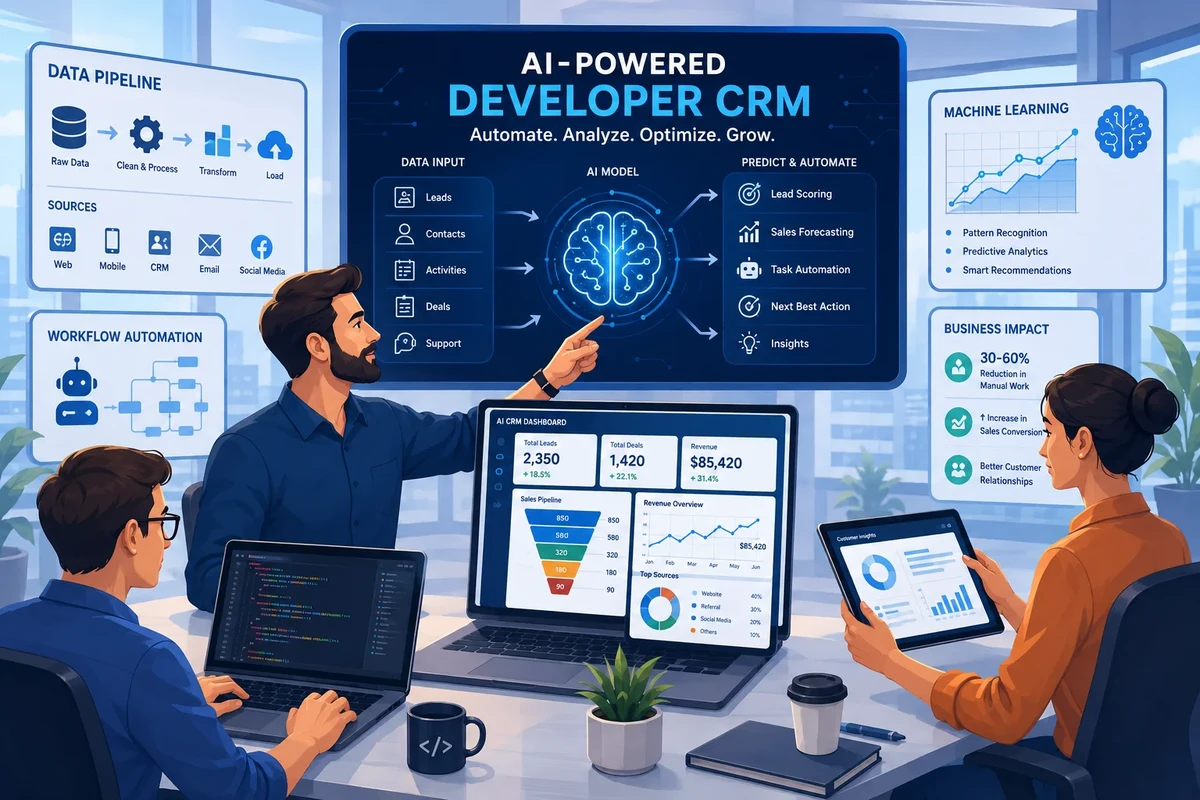
By 2026, AI-powered CRM systems are transitioning from passive recording tools and reactive copilots into autonomous multi-agent operational networks. Instead of merely generating response drafts or scoring opportunities, 2026 platforms coordinate specialized AI agents to execute end-to-end customer lifecycle tasks, automate cross-functional handoffs, and deliver real-time relationship intelligence directly into sales and service workflows.
According to findings published in Creatio’s report, The State of AI Agents and no-code, 86% of C-level decision-makers declare AI agents will be important to strategic goals over the next two to three years. This shift reflects an evolution across three distinct operational eras: CRM 1.0 served as static digital rolodexes focused on record keeping; CRM 2.0 introduced cloud-hosted predictive scoring and tracking; CRM 3.0 establishes autonomous execution environments where specialized software agents conduct research, update pipeline records, and initiate outreach without waiting for manual human instruction.
The Agentic Shift: Moving Beyond Copilots to Autonomous Execution
In 2026, AI CRM shifts from conversational copilots to autonomous agentic architectures. Instead of merely suggesting next steps or drafting text, multi-agent systems independently analyze intent signals, enrich records, execute omnichannel outreach, and adjust live campaigns in real time, transforming CRM from a passive system of record into an active execution engine.
From Task Recommendation to Autonomous Execution
Enterprise CRM architecture has fundamentally outgrown the reactive copilot paradigm. Microsoft Dynamics 365 implementation partner AlphaBOLD notes that in 2026, AI in CRM is no longer centered on predictive analytics or task automation; the defining shift is the rise of agentic AI, where CRM systems execute complex operational workflows autonomously rather than merely recommending them to human operators. Earlier generative tools relied on human prompts to produce individual emails or summarize call transcripts. By contrast, agentic platforms independently parse incoming customer signals, determine appropriate remediation steps, and execute cross-channel actions without requiring human initiation at each step.
“Agentic automation is not simply another technology trend. It is the foundation of how enterprises will innovate, compete, and grow in the AI Economy.”
The Rise of the Agentic Operating Layer
As organizations transition from AI-averse to AI-first strategies, software agents are forming a continuous operational layer across the enterprise revenue engine. Industry analysis from publication CIO documents that agentic architectures mark a structural departure for enterprise business software. Instead of functioning as peripheral plug-ins, autonomous agents continuously monitor customer interactions across voice, email, and meeting transcripts. When an account exhibits churn signals or expansion opportunities, agents autonomously adjust account priority ratings, allocate targeted marketing collateral, and trigger outbound engagement sequences while synchronizing data across operational databases.
Multi-Agent Systems vs Traditional Role-Based AI
The structural evolution of enterprise customer management centers on replacing isolated task automations with collaborative agent networks. Technology research firm Forrester outlines a critical industry transition: enterprises are migrating away from siloed, role-based artificial intelligence toward collaborative multi-agent CRM architectures. Rather than relying on single-purpose bots operating in functional vacuums, modern systems deploy collections of specialized agents that share contextual memory, synchronize actions, and resolve operational bottlenecks across departments.
Siloed Task Handlers vs Shared Context Networks
Traditional CRM implementations assigned narrow AI models to isolated tasks, such as routing support tickets or evaluating form submissions. These single-task bots operated without shared context, forcing sales and service personnel to manually bridge information gaps between disparate departments. Modern multi-agent ecosystems operate on a shared context fabric. Market data documented by Creatio projects a 35% five-year growth in the market for industry-specific AI agents, reflecting enterprise demand for domain-tailored agent networks capable of interpreting nuanced regulatory, transactional, and vertical-specific customer journeys.
Cross-Functional Coordination Without Human Hand-offs
Multi-agent coordination eliminates the administrative latency that historically plagued enterprise handoffs between marketing, sales engineering, and customer success. In an autonomous 2026 framework, when an enterprise prospect engages with specialized technical documentation, an inbound analysis agent assesses account intent, collaborates with an account enrichment agent to map organizational buying committees, and alerts an engagement agent to dispatch custom technical briefs. The entire workflow executes across departments without requiring manual data entry or intervention from sales development representatives.
The operational table below compares the architectural distinctions, contextual scope, and handoff requirements across the three generations of CRM intelligence.
Capability Dimension |
Legacy Role-Based AI |
Generative Copilots |
2026 Multi-Agent Systems |
|---|---|---|---|
Execution Autonomy |
Rule-bound; executes static if-then routines without situational adaptation. |
Interactive; generates text drafts and summaries upon manual user prompting. |
Autonomous; independently evaluates intent signals, initiates workflows, and adapts execution. |
Cross-Functional Context Sharing |
Isolated within specific department databases; zero cross-functional memory. |
Fragmented; session context resets across different application windows. |
Continuous; unified event bus synchronizes customer state across marketing, sales, and service. |
Manual Handoff Frequency |
High; sales reps manually re-enter data and assign records between stages. |
Moderate; human review and manual clicking required to send suggested content. |
Minimal; agents handle end-to-end task execution, escalating only predefined exceptions. |
Operational Scope |
Single-task execution (e.g., email open logging, basic ticket routing). |
Assisted task completion (e.g., drafting prospect replies, meeting summaries). |
End-to-end lifecycle orchestration (e.g., discovery, multi-stakeholder enrichment, contract renewal). |
Evaluating these architectural dimensions enables revenue operations teams to distinguish between superficial chatbot interfaces and genuine multi-agent architectures that reduce administrative drag.
Solving the 12% Frontline Adoption Paradox
Enterprise investment plans stand in sharp contrast to frontline sales floor reality. Industry research identifies a profound operational gap: while 81% of organizations planned to adopt AI-powered CRM systems by 2025, only 12% of CRM users actively use an AI tool in their daily processes. Bridging this chasm requires revenue leaders to understand the mechanical failures that cause frontline teams to abandon automated tools.
Operational Warning: Bolting generative AI add-ons onto fragmented legacy databases creates severe prompt fatigue and user distrust. When sales representatives spend more time troubleshooting AI suggestions than closing deals, active tool utilization collapses to the observed 12% baseline.
The Root Causes of Frontline Utilization Drop-Off
Frontline utilization drop-off stems from interface friction, prompt fatigue, and black-box automation. Traditional sellers resist systems that require conversational prompt engineering just to extract pipeline updates. When early generative copilots produced generic email drafts or irrelevant deal recommendations, sales professionals quickly reverted to manual spreadsheets and external note apps. When algorithms assign predictive lead scores without providing transparent reasoning, account executives distrust the ranking and waste hours manually verifying account qualifications.
Financial architecture also influences adoption sustainability. Organizations transitioning from fixed per-seat SaaS licenses to token consumption tiers, usage credits, and pay-per-agent-resolution pricing encounter volatile software expenditures. When unmonitored agent loops generate unexpected API costs without verifiable revenue acceleration, finance departments frequently mandate usage caps that disrupt frontline workflows and depress daily platform usage.
Unified Data Fabrics vs Bolted-On Legacy Additions
The architectural failure of many CRM rollouts lies in retrofitting AI modules onto disconnected, legacy relational databases. Industry analysis emphasizes that in 2026, CRM performance no longer depends on raw data accumulation or network volume, but on data actionability and uncovering hidden relationship pathways to key decision-makers. Furthermore, market forecasts predict that by 2028, 80% of generative AI business applications will be developed directly on existing data management platforms.
Unified architectures—such as the native ecosystem found in Zoho CRM—bind execution agents directly to the primary operational data layer. Disconnected systems rely on brittle third-party connectors and scheduled synchronization batches that result in data latency. In contrast, unified data fabrics supply agents with continuous, clean transactional context, preventing conflicting record updates and ensuring automated actions align with accurate account histories.
Designing Trust-Driven and Explainable Interfaces
AlphaBOLD notes that CRM interfaces in 2026 are shifting from cosmetic navigation convenience toward trust-driven, explainable human-agent collaboration. To achieve widespread frontline adoption, CRM interfaces must provide explainable reasoning behind every autonomous action or recommendation. Rather than displaying an isolated score, modern systems present transparent audit trails showing the specific behavioral triggers, email interactions, and market events that prompted the agent’s proposal.
Operational change management requires establishing explicit human-in-the-loop (HITL) approval gates. Revenue operations leaders should configure tiered autonomy thresholds where routine data enrichment occurs autonomously, while high-stakes actions—such as dispatching enterprise pricing proposals or reassigning strategic territory accounts—require explicit confirmation from sales management. By keeping humans firmly in control of strategic decisions while delegating administrative tasks to background agents, enterprises overcome user resistance and convert skepticism into measurable productivity.
Multimodal Intelligence and Real-Time Lifecycle Execution
AI CRMs in 2026 achieve measurable operational gains by unifying multimodal signal analysis with automated execution. Enterprise deployments demonstrate handle time reductions up to 70%, 40% higher conversion rates, and 65% less manual data entry through automated call summarization, voice and video sentiment tracking, and continuous data enrichment.
Creatio emphasizes that enterprise AI CRM adoption in 2026 is evaluated strictly on concrete operational performance—quantified through hours saved, operational cost reductions, and output velocity—rather than speculative feature innovation. Industry analysts point out that CRM intelligence has expanded far beyond text analysis into multimodal processing of voice, video, and visual cues. In the telecommunications sector, Bouygues Telecom deployed generative AI call summarization in partnership with IBM, reducing customer service call handle times by 30%.
Multimodal models interpret subtle acoustic cues, vocal inflection, and speech pacing during sales discovery calls. During video presentations, computer vision tools analyze stakeholder engagement, attention shifts, and visual reactions to specific proposal slides. These behavioral signals are automatically processed to adjust opportunity health scores and update relationship mapping graphs in real time. Enterprise deployments document quantifiable efficiency and revenue gains across core operational benchmarks:
- Elimination of Administrative Overhead: Enterprise case study data from deployments at XYZ Corp demonstrates a 65% reduction in manual data entry for sales representatives, returning hours of selling capacity to account teams each week.
- Customer Service Acceleration: Creatio performance benchmarks show potential call duration reductions reaching 70% and operational cost reductions up to 60% through real-time agent assist and automated post-call record updates.
- Accelerated Pipeline Velocity: Implementing AI-driven lead scoring delivered a 40% increase in lead conversion rates and shortened enterprise sales cycles by 25% at XYZ Corp, generating $2 million in total annual ROI and a 5x return on CRM investment. Across broader industry implementations, automated lead scoring generated a 45% increase in lead-to-opportunity conversions, with 98% of sales teams reporting improved lead prioritization.
- Proactive Account Retention: Using automated systems to proactively deliver customer interactions at optimal touchpoints produces a 5% to 8% lift in revenue and a 15% to 20% increase in customer satisfaction, contributing to a 30% reduction in customer churn at XYZ Corp.
- Total Market Expansion: Market research projects the global CRM software market to reach $128 billion by 2028.
Enterprise Risk Controls and Implementation Pitfalls
Deploying autonomous multi-agent CRM systems introduces operational, legal, and architectural vulnerabilities that require proactive technical governance. When autonomous software agents possess write access to customer databases and direct communication channels with clients, enterprise IT leaders must enforce strict operational constraints to prevent data corruption and regulatory non-compliance.
Customizing models for specific enterprise sales motions requires disciplined fine-tuning protocols. Technical analysts at CleverX Team define the baseline mechanics of model adaptation:
“Fine-tuning means taking an already-trained AI model and giving it extra training on specific information, so it can perform better at certain tasks or within particular fields.”
Fine-tuning general models on narrow, proprietary CRM data carries acute technical risks. When models are over-trained on small sales datasets, they frequently suffer from model overfitting or catastrophic forgetting, losing general conversational reasoning and generating fabricated customer interaction histories that corrupt pipeline forecasting.
Systemic Risk Warning: Multi-agent workflows are vulnerable to hallucination cascading and automated record pollution. If an upstream agent misclassifies customer intent and updates account fields with erroneous data, downstream agents ingest that corrupted context, initiating unauthorized discounts, flawed support escalations, or incorrect legal terms.
To insulate enterprise operations against systemic disruption, revenue operations and IT leaders must implement five core architectural controls:
- Audit Logging and End-to-End Encryption: Implement immutable audit logs tracking every agentic decision, data query, and autonomous execution. Enforce end-to-end encryption standards to ensure proprietary relationship data and customer personally identifiable information (PII) never leak into external foundation model training corpuses.
- Cross-Border Compliance and Legal Integration: Integrate legal and compliance teams into initial architecture design to navigate regulatory frameworks, including the European Union AI Act, automated profiling restrictions, and consumer transparency requirements governing synthetic commercial communications.
- Human-in-the-Loop (HITL) Circuit Breakers: Establish deterministic fail-safe protocols and execution kill-switches. High-risk actions—such as outbound contract distribution, payment terms modification, or major account reassignments—must be held in staging environments until validated by authorized human managers.
- Vector Memory Sovereignty: Guard against vendor lock-in by retaining strict ownership and platform-independent export rights over vector embeddings, customer relationship graphs, and historical agent interaction logs, ensuring enterprise context remains portable across evolving underlying LLM providers.
- Edge SLM Performance for Mobile Teams: Deploy localized Small Language Models (SLMs) on mobile hardware for field sales personnel, providing reliable offline performance, zero network latency, and local data protection during client visits in areas with compromised network connectivity.
FAQ
What is the key difference between a CRM copilot and an agentic CRM in 2026?
CRM copilots function reactively by drafting text or answering user prompts, whereas agentic CRM systems autonomously coordinate multi-step workflows. Agentic systems independently analyze intent signals, enrich contact records, and trigger outbound interactions across customer touchpoints based on real-time event triggers without requiring manual human initiation.
Why is there a gap between planned AI CRM adoption and actual frontline usage?
While 81% of organizations plan AI CRM rollouts, only 12% of frontline reps actively use these tools. This adoption chasm stems from prompt fatigue, workflow friction on bolted-on legacy databases, and black-box automation that fails to provide explainable reasoning or verifiable citations to sales personnel.
How does multimodal AI enhance CRM performance beyond text analysis?
Multimodal AI evaluates non-text inputs such as vocal cadence, speech inflection, and video engagement patterns during live client calls. By identifying acoustic hesitation and micro-expressions that text transcripts overlook, multimodal models automatically update deal health scores, sentiment tracking, and relationship intelligence graphs.
What risks should enterprise IT address when fine-tuning models on CRM data?
Fine-tuning models on proprietary CRM data introduces risks of catastrophic forgetting, overfitting on narrow sales records, and proprietary data leakage. Enterprise IT leaders must enforce immutable audit logs, end-to-end encryption, strict retention policies, and human-in-the-loop circuit breakers before granting agents autonomous write permissions.
How is AI CRM adoption evaluated in 2026?
In 2026, AI CRM adoption is evaluated based on concrete operational efficiency rather than feature novelty. Enterprise decision-makers measure success through quantifiable benchmarks, including reductions in handle times, lower customer acquisition costs, automated data entry elimination, and accelerated pipeline conversion velocity.